
Crop Insurance: Smart, Fiscally Responsible Farm Policy

Every county in the state of Iowa is experiencing severe or extreme drought conditions, according to the U.S. Drought Monitor. This time last near, not a single county in the state was experiencing drought. In fact, it would be fair to say that farmers saw quite the opposite conditions last year, especially here in Western Iowa.

We had water, and lots of it. In fact, counties bordering the Missouri River had thousands of acres of farmland – homes and communities – that were under water for four months. The Missouri River, which is typically less than 1,000 feet wide, was roughly six miles wide from bank to bank.

From a farmer’s perspective, the only thing last year and this year have in common is that crop losses will be steep. But this is the nature of agriculture, where we are blessed with some of the most productive land on earth in the good years, and then the threat of losing an entire crop, back to back, in the bad years. Thank goodness most farmers purchase crop insurance to help us get back on our feet after those bad years strike.

Last year, Iowa farmers shelled out more than $444 million from their own pockets to purchase crop insurance. Crop insurance has become the best risk management tool available for most farmers because it is a public-private partnership that limits taxpayer exposure to risk and helps farmers get back on their feet when disaster strikes.

Prior to widespread participation in crop insurance – which in 2011 protected 84 percent of eligible lands – farmers would often rely on federal disaster relief when a flood, or drought, or both, wiped them out. This disaster relief was not cheap for the taxpayers, who funded a string of relief bills totaling $45 billion from FY1989 to FY2001 for this very purpose.

While the disaster bills were greatly appreciated by the farmers who received them, they took a long time to arrive – up to two years – to get into the hands of the farmers who had lost everything and needed those funds badly.

Because crop insurance is sold, managed and delivered by the public sector, the indemnity checks come in a much more timely manner. In fact, more than $1 billion has already been paid out nationally to farmers who suffered losses this year.

For those worried about federal spending, crop insurance is a smart, fiscally responsible farm policy. It requires farmers who want protection to put some “skin in the game,” in the form of purchasing premiums, and it only benefits those who suffer a real, verifiable loss. As crop insurance has grown in use, spending on farm safety net programs as a whole has dropped from $19.2 billion in 2002 to an estimated $12.3 billion in 2011, a 36 percent decline.

Because we are blessed with great soil and a usually amenable climate, many Iowa farmers – and others in the Corn Belt – rarely collect indemnities. The returns that the companies have made over the years, combined with the $3.5 billion the federal government has made in underwriting gains, will help pay for big losses, like the ones we have experienced back to back this year.

But like all farm policies, crop insurance has taken its fair share of criticism from those in Washington who would like to see a much less robust agriculture sector. These critics are actually using this year’s drought to paint farmers as self-serving and living off the government; people who, according to the Environmental Working Group, are “praying for drought, not rain.”

What nonsense! Suffice it to say that only in Washington DC would a group think that a check for an insurance loss could possibly be anywhere close to as satisfying – both financially and emotionally – as a bountiful harvest. The statement is ludicrous, and would lead one to conclude that people purchase car insurance in the hopes of having a bad wreck and cashing in on that misfortune.

Some rains have returned to Iowa but in most cases, it’s too late for the corn crop, of which 53 percent is considered in poor, or very poor condition. The rains will not renew our crops, but they do remind us of the promise of the future. But promises don’t pay creditors, so in addition to the rain, I’ll be thanking my good instincts for purchasing crop insurance yet again this year. Because I can tell you for certain, that if I hadn’t purchased multi-peril crop insurance this year with the drought, or last year with the flood, I’d be out of the farming business altogether.

Richard Archer is a corn and soybean farmer from Onawa, Iowa

This op-ed appeared in the Sioux City Journal on October 3, 2012.
Montana Farmers Need A Strong Crop Insurance Policy

There are those who say that the grass is always greener on the other side of the fence. But the opposite can be true as well. Sometimes, it’s not until you look on the other side of the fence that you realize just how green your own grass is.

That’s certainly true this year. After good precipitation in the spring, weather in eastern Montana has been on the dry side since July; but the drought is not yet as severe as that in the Midwest weather is top of mind every year, since I’m a farmer who worries every year when I plant 2,300 acres of durum wheat, peas, lentils, flax and canola.

Last year, it was so wet from spring rains that I couldn’t get all of my land seeded. This year, after a promising start, it has become too dry. Mother Nature can be unpredictable, and a few bad years in a row without a good risk management strategy in place could mean the end of your farming career. That’s why I’ve purchased crop insurance every year since I started farming in 2001.

Crop insurance is a public-private partnership that not only reduces taxpayer exposure to risk, but also saves them money. When disaster struck last year with floods in the Midwest, drought in the Southern Plains and hurricanes on the East Coast, farmers who lost everything didn’t send their representatives back to Washington asking for a big farm disaster bill.

How was that avoided, given the extent of last year’s damage? Farmers didn’t need a disaster bill because 84 percent of eligible crops were protected by crop insurance. Prior to the emergence of crop insurance as the top risk management tool for farmers, natural disasters regularly triggered very costly, unbudgeted ad hoc disaster bills from Congress, costing taxpayers $45 billion from FY1989 to FY2001. Those days are over.

Crop insurance is no small expense for those of us who purchase it, but generally is the best – and in some cases the only – risk management tool available to many farmers nowadays. Crop insurance forces farmers to “put some skin in the game” by purchasing the insurance and taking charge of their own risk management strategies. Here in Montana, more than 16,000 farmers paid more than $85 million to purchase policies to cover their potential losses in 2011.

In the tight financial times we live in, crop insurance is a smart and efficient farm policy. In fact, as crop insurance has grown, taxpayer spending for farm safety net programs as a whole has dropped from $19.2 billion in 2002 to an estimated $12.3 billion in 2011, a 36 percent decline.

While the government pays a portion of a farmer’s premium – which is a way to encourage as much participation in the program as possible – the government and private insurance companies share in the losses and gains of the program. The government has made more than $3.5 billion in underwriting gains over the last several years and that money goes right back into the U.S. Treasury.

With the large amounts of capital required to plant a crop every year, crop insurance is essential for farmers who have to go to banks for operating loans. That’s because the banks see a crop insurance policy as a form of collateral, making their loans to farmers less risky and thus helping to inject billions of dollars into rural America.

Because crop insurance is sold, managed and delivered by the public sector, the indemnity checks come in a much more timely manner. In fact, more than $1.4 billion has already been paid out nationally to farmers who suffered losses this year, with roughly $25 million of that coming to farmers with losses in Montana.

Of course there are those in Washington who seem to forget that they eat three meals a day and criticize every dollar spent on farm programs. They say that farmers in the drought-stricken areas are actually “praying for drought, not rain,” with the implication being that farmers would rather collect a crop insurance check than sell a bountiful harvest. That’s like saying that people purchase car insurance praying for an auto wreck. Not to mention the fact that in many years I purchase a crop insurance policy and don’t collect a dime. Period.

Yes, farming is a risky business, but for those of us who grow food, feed, fuel and fiber for consumers here and abroad, it’s a way of life. Some people might say that the grass is greener on the other side of fence, but because of crop insurance, the grass can be greener on both sides of the fence.

Chris Westergard is a fourth-generation farmer who lives near Plentywood, Montana.

This op-ed appeared in the Billings Gazette on September 30, 2012.


Crop Insurance Saved Taxpayers $10.4 Billion Since 2002

Federal crop insurance has come in under budget every year since 2002 – the last year of major revisions to the program – saving taxpayers more than $10.4 billion in projected spending, according to a new analysis of Congressional Budget Office (CBO) data.

The savings, taken as the difference between the projected cost of the crop insurance program by the CBO and the actual cost of the program, shows that in some years, the CBO overestimated the cost of crop insurance by more than 45 percent.

Year CBO   Estimate($ bil.) CBO Actual($bil.) Difference($ bil.)
2002 2.876 2.818 0.058
2003 3.179 2.906 0.273
2004 3.682 3.366 0.313
2005 3.626 2.242 1.384
2006 3.864 3.291 0.573
2007 4.670 4.374 0.296
2008 7.746 4.146 3.600
2009 7.496 6.767 0.729
2010 7.784 4.547 3.237
Total   Savings $10.4   billion

For example, the difference between projected and actual cost ranges from being 6.3 percent too high in 2007 to 46.5 percent too high in 2008.  In 2010, the most recent year for which final data are available, the CBO estimated the cost for crop insurance would be $7.784 billion, but the actual cost of the program was $4.547 billion, or 41.4 percent lower than projected.

The constant discrepancy is due to the fact that the CBO always assumes that the gross premiums—which include what the farmers pay and the government premium subsidies—will be equal to the indemnities paid out, which in the real world, is almost never the case.

Whenever the gross premiums exceed the indemnities paid, this excess is called the “gross underwriting gain.”  This excess is divided between the Federal Crop Insurance Corporation (FCIC) and the private insurance companies.  When the government’s share of the underwriting gains are positive, they help offset the cost of the premium subsidies provided to farmers.  Such positive gains reduce the actual cost of the program to the taxpayers below what CBO had expected.

And these government underwriting gains and overestimates in the cost of the program have been consistent in recent years, and may continue into the future,    while overestimates are the long running pattern and may continue in the future, although 2011 may prove to be one of the exceptional years given the record indemnities due to drought, floods, hurricanes and freezes.

Despite the size of the nation’s food and agriculture sector and the fact that agriculture has been a major economic factor in lifting this nation out of the long recession, federal investment in crop insurance is less than one-tenth of one percent of overall federal spending.

Strong Financial Underpinning A Key Requisite to Strong Crop Insurance Policy

Because of the magnitude of risk inherent in U.S. agriculture, combined with the large volume of commodities produced, companies that participate in the Federal crop insurance program are mandated by law to have ready access to large pools of liquid capital so they can meet their obligations if disaster strikes the farming sector. These rigorous financial requisites all but demand the involvement of reinsurers – large, financially fortified companies that provide insurance to insurance companies – to ensure that payments arrive to farmers for the policies they purchase in a timely fashion.

Never before in the history of the Federal Crop Insurance Program was the extent of the risk and financial exposure so evident as in 2011, which saw record indemnities in excess of $10.4 billion paid by private companies to farmers for their losses. This makes 2011 the most expensive year ever, topping the old record set in 2008 of $8.67 billion in indemnities by 20 percent. And with commodity prices rising due to tight markets and increased domestic and global demand, there will likely be an increased need for crop insurance, which protected over $113 billion worth of crops in 2011.

Although crop insurance has already been subjected to $12 billion in federal funding reductions, further reductions could raise questions of the federal commitment to the existence of a robust and effective crop insurance policy. “An unrecognized danger is that additional budget cuts will prove counterproductive in the long run, driving away the reinsurance companies that have long played a crucial role in the program’s growth by putting a substantial amount of their capital at risk,” says Jim Christianson, Managing Director, Guy Carpenter & Company, LLC.

Christianson notes that any pullback by reinsurers would have serious repercussions in the market and would, in the end, leave the federal government and the U.S. taxpayer to shoulder a greater portion of the cost of future catastrophes that hit the country’s agriculture sector.

As recently as the early 1990s, farmers purchasing crop insurance hovered around 30 percent. But the program has expanded dramatically since and in 2011, more than 1.1 million policies were written, covering 83 percent of eligible farmland and 128 crops in all 50 states. And the continued climb in commodity prices means an increase in the amount of risk that will be protected annually.

“Today, reinsurers from around the world find the U.S. crop insurance market to be a welcome addition to their portfolios,” said Christianson.

Reinsurers are keeping a watchful eye on Congress and lawmakers as they write the 2012 Farm Bill. ”Congress should be very cautious about considering the adoption of any other policies that would weaken the already over-extended crop insurance infrastructure or divert the much needed reinsurance investments elsewhere,” he added.

What Does 2012 Hold for Crop Insurance? 

With 2011 indemnities quickly approaching the all-time record of $10 billion, and farmers preparing to plant another impressive crop just months after the worst weather year in U.S. history, the current crop insurance system is earning high praise from agricultural leaders and lawmakers alike.

But in a new peer-reviewed analysis that appeared in January’s Choices magazine, former USDA Chief Economist Keith Collins and Harun Bulut, National Crop Insurance Services (NCIS) senior economist, explained that many proposals to alter crop insurance policy in the 2012 Farm Bill could hold serious ramifications for farmers and taxpayers, and could weaken the very system that proved so crucial last year.

Among the shortfalls they highlighted: Displacing private-sector crop insurance with duplicative government-run programs; saddling farmers and taxpayers with greater risk exposure; increasing program complexity; increasing taxpayer cost; and reducing farmer participation and coverage levels.

“With deficit reduction in prospect for years to come and insurance so fundamental to risk management in all economic areas, the long-term most sustainable safety net program for farmers may be enhanced crop insurance,” the authors wrote.

Collins, who attended an annual convention sponsored by NCIS, urged people to consider the past and present before writing the future.

“Let’s not lose sight of the fact that the current system took three decades to build and is working as designed,” he said at the conference. “The public-private partnership was created to reduce taxpayer risk by encouraging farmers to purchase insurance from professionals skilled in delivering private-sector payments quickly.”

Since modern-day crop insurance was first created in 1980, participation and coverage levels have grown dramatically. Nearly 265 million acres were insured by $114 billion worth of liability coverage in 2011, up from 45 million acres and $6 billion in coverage in 1981.

“My advice moving forward,” Collins concluded, “consider all consequences before restructuring crop insurance. The unintended consequences could harm three decades of success and upend some of the essential strengths that make the current system so great for farmers and taxpayers.”


Nation Cotton Council CEO Says Key Crop Insurance Strength Is Private Sector Delivery

While a record amount of indemnities – approaching the $10 billion mark – are being paid to farmers for 2011, one of the key aspects of crop insurance that makes it a favorite among farmers is its private sector delivery, which sets crop insurance apart from all other policies, said Mark Lange, president and CEO of the National Cotton Council.

During a recent interview with the National Association of Farm Broadcasters, Lange pointed out that crop insurance’s speed of delivery was well on display in 2011 in West Texas – where many growers didn’t even see their fields sprout – but they had their indemnities in hand quickly, allowing them to farm yet another year. “They are dry land growers, and they are seeing crop indemnities paid prior to Labor Day,” he said.

Lange noted that another strength of crop insurance, from the growers’ perspective, is that “crop insurance policies come in a vast array of styles and coverage and the grower can very closely tailor the specific policy that they are acquiring to their specific farm situation.”

Lange says that Congress has a daunting challenge, since crafting a Farm Bill with elections fast approaching and with budgets declining will not be easy. But he believes that what emerges will preserve the public-private partnership of crop insurance and ensure the long-term viability of America’s food and fiber supply.

“I think it’s clear that the delivery of insurance or revenue programs from the government has a very chilling effect for agricultural producers,” he said, and it takes far too long for help to arrive into the hands of the farmers. “The SURE program, is just now providing benefits for losses that occurred in 2009,” he said. “So here it is in early 2012 and they’re just getting the benefits. That’s just too long.”

To listen to Lange’s interview in its entirety, click here.

Kansas Farmer: One Size Doesn’t Fit All When it Comes to Risk Management

When it comes to risk management, one size does not fit all, said Kansas farmer Jay Armstrong during a recent radio interview with the National Association of Farm Broadcasters that ran nationally in early December. Armstrong noted that his 2,700-acre family farm is split between upland and bottomland. In years of drought, the upland withers while the bottomland blossoms. In years of wet weather, it’s the opposite.

“So no matter what extreme Mother Nature throws at me I will suffer losses,” he said, adding “my story is the story of many thousands of farmers across this country, who grow our nation’s food, feed, and fuel supply while dealing with Mother Nature’s tantrums, year in and year out.”

Armstrong says most farmers would agree that the single most important item in their risk management tool kit is crop insurance. He says that before federal crop insurance became widely available several decades ago, farming on land like his felt like playing Russian roulette. “It was nearly impossible to get any kind of coverage for managing risks on my farm where flooding or drought was an occasional occurrence because the private sector just wouldn’t offer it.”

“But federal crop insurance took the universality of the public sector and made these important risk management tools available to everyone willing to pay for them,” he said. Armstrong called crop insurance “the quintessential tool” for managing farms risks because each farmer can choose the plan that makes the most sense for their operation

Armstrong also said that crop insurance has made him a better businessman, allowing him to market his grains, including corn, soybeans and wheat, well in advance because they are insured. “If my crop comes up short at the end of the year because of poor weather – or fails altogether – the insurance indemnity is there to purchase the grain to fulfill my marketing contracts at the end of the year.”

Crop insurance was designed by Congress to shield taxpayers from costly weather-induced bailouts that became commonplace in past decades – and Armstrong says it’s working. 2011 might be regarded as one of the worst weather years on record, with crop insurance companies paying out more than $6 billion. But Armstrong points out that with roughly 80 percent of eligible acres covered by crop insurance, there is no need for disaster bills.

Crop Insurance: Private Sector Participation Enhances Policy Efficacy

Most would agree that the private sector excels at some tasks while the government is better-suited for others. This melding of the private and public sectors has yielded a crop insurance policy with affordable premiums, personalized risk management solutions and a private delivery system that puts needed monies into the hands of farmers when timing is critical.

Crop insurance covers 128 crops, including all major grain crops and cotton, nursery, citrus, rice, potatoes, and livestock. Farmers can cover their crops for all natural disasters, including wildfire, earthquake, volcanic eruptions and even irrigated water issues. Because the policy is personalized, each farmer tailors the policy to match his specific risk and desired coverage.

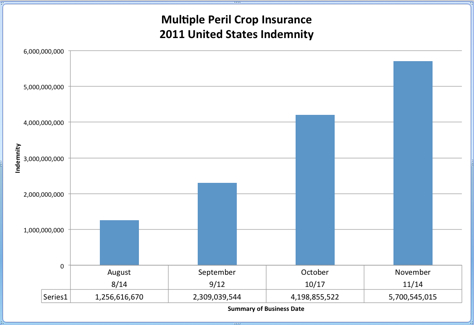
To date for 2011, the crop insurance program has paid out over $5.7 billion in indemnity payments to America’s farmers and ranchers, and that number will continue to rise over the next few months.

Corn and soybean farmer Quentin Bowen, who operates a family-farm in Humboldt, Nebraska, says that when disaster strikes, the difference in delivery of benefits when comparing government-run programs to the private sector’s handling of crop insurance, is like comparing night to day. “The speed of delivery of crop insurance—because it’s administered by private sector companies—makes it a different kind of animal. In fact, if a natural disaster strikes and I’m covered by a crop insurance policy, typically the payment comes to me in one or two weeks, not in one or two years,” he said in a recent guest column.

Following the submission of recommendations to the Super Committee for cuts in agriculture, major farm groups made clear their strong feelings on crop insurance.

In a letter to House and Senate Ag leaders, The National Association of Wheat Growers (NAWG) stated that “our highest priority for federal investment in agriculture programs is the portion of crop insurance premiums subsidized by the federal government, the public part of one of the most well-functioning public-private partnerships undertaken by our government.” NAWG also reiterated its conviction that crop insurance is the cornerstone policy for risk management, adding, “We believe crop insurance is essential to the farm safety net and the reliable production of an abundant food supply.”

A similar statement from the National Corn Growers Association noted, “the highest priority for NCGA is securing a strong crop insurance program.”

And crop insurance is apparently working quite well this year for America’s farmers, particularly those farming corn, cotton, grain sorghum, soybeans and other crops in drought-ravaged Texas. The October 23 Houston Chronicle reported that more than 41,000 farmers in Texas have received $1.65 billion so far from the national crop insurance program to help compensate for disastrous low yields and other damage caused by the state’s worst drought in history.

“The crop insurance is the linchpin and heartbeat of recovering and muscling through the disasters,” said Karis Gutter, the U.S. Department of Agriculture’s acting deputy undersecretary, who oversees all federal disaster relief efforts and foreign exports. “It will help folks get back to a semblance of normalcy in their lives.”

When farmers are trying to pick up the pieces after disaster strikes, an inefficient payment or delivery system is the last thing they need to be dealing with.

Living on a Prayer

By John Thamert

Agriculture is collectively holding its breath as the “super committee” meets to determine where the $1.2 trillion worth of federal budget funds will be cut. Having already shouldered more than $12 billion in cuts for deficit reduction in the past several years, farmers and ranchers feel the pain that other sectors have yet to experience.

With this massive overhaul on the horizon, the Senate Agriculture Committee traveled to Wichita, Kansas, late last month to hear from farmers, bankers and local elected officials about what they thought were the necessary components of a strong and viable Farm Bill.

Farmers representing every crop from corn to cotton, bankers who loan to businesses of all sizes, and key elected officials all delivered one main message that was eventually heard all the way back to the halls of Congress: Crop insurance is one of the most important components of farm policy—it should not be touched.

Senator Debbie Stabenow (D-MI), the committee’s chair, recognizes that the upcoming farm bill will not only impact farmers and ranchers; it will also affect those workers who process, package and market agricultural products and services.

This is no small item when you consider that there are over 21 million jobs tied directly to the U.S. agricultural industry.
Obviously, crop insurance is not a policy used by every American—particularly those in urban areas who write about it. But as a banker, a farmer, and a resident of rural America, I see firsthand the benefits of crop insurance and its essential place in a farmer’s arsenal of risk management tools. “Some folks question the need for a Farm Bill with commodity prices where they are today,” Senator Pat Roberts (R-KS), the committee’s ranking member said. “I don’t have to tell this crowd that prices can fall much more quickly than they rise.”

So let me explain why farmers and agricultural lenders from all corners of the country are crying out in unison for maintaining crop insurance.

Crop insurance is a public-private partnership that combines the flexibility and efficiency of the free market with the support of the public sector, to ensure that a modest government investment is able to provide an economic “safety net” for a very unpredictable and high-risk industry.

In so doing, when farmers and/or ranchers experience a severe reduction in their cash flow due to a natural disaster they can depend on crop insurance to cover some of the loss. Any claim paid to a farmer or rancher will create dollars that can be used to cover operating loans from their bank, to pay for fuel, crop and machinery costs; all of which flow through the economies of our country’s small towns and rural communities.

Farmers need crop insurance as an economic “safety net”. Consumers need crop insurance so that they can take comfort in knowing that one of our nation’s premier industries, which provides an abundant and affordable food supply, will remain viable. And lenders need crop insurance in order to be confident that their investment in agriculture will be sound—and around it goes.

One other important consideration is helping the next generation of farmers and ranchers continue our nation’s dominance in food production. Finding a lender willing to invest in a young farmer is hard enough as it is. More often than not, they have very little capital. In these times of rising input costs, a volatile world economy and unpredictable weather patterns, the one thing that lenders and their young farm customers are able to rely on is the crop insurance policy.

“Certainly, farmers here in Kansas know the importance of a strong farm safety net,” Senator Stabenow said at the hearing. “You’ve been dealing with a record drought this year that is devastating crops and livestock production. Suffice it to say, if we ever needed a reminder about the risks farmers face, we got it this year.”

She’s right. Without crop insurance, I’m not sure that my operation would still exist—and the same goes for many of my neighbors—not just in Kansas but in the Texas panhandle where they haven’t seen a drop of rain since October 17, and Missouri, where flooding has left thousands of acres under water and unproductive.

The Senate Agriculture Committee asked for our input: “What are the risk management tools that farmers in the great state of Kansas need? What should an effective farm safety net look like? What are your priorities? What programs can we streamline or consolidate?” And the answer was nearly unanimous: No more cuts to one of the few remaining – and in most farmers’ judgment, the best – risk management tools. If you must cut from agriculture, do not cut crop insurance.

To our farmers and ranchers dealing with severe drought or other natural disasters, these are very trying times; to see high prices without any product to sell and yet have to put out next year’s crop with record high input costs. Without crop insurance, these producers would go out of business as well as cause economic harm to a number of their business providers. I would ask my fellow farmers and bankers to contact their senators and representatives and convey the magnitude of our concerns. Farming without strong farm policy, is nothing but living on a prayer.

John C. Thaemert is a Vice President & Trust Officer at Citizens State Bank & Trust Co. in Ellsworth, Kansas as well as past president of the National Association of Wheat Growers. Thaemert is a third generation farmer who resides in Sylvan Grove, Kansas.

This op-ed appeared in Agri-Pulse on September 6, 2011.